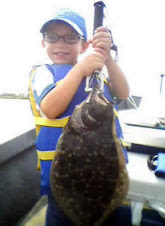
If you have never been Flounder gigging you are missing out on some really great fun. I started a couple of years ago by going with a friend that has been doing it for over 20 years now. If the idea of combining some hunting skills with your fishing skills, having the water all to yourself, and getting a cooler full of fresh flounder sounds good to you then read on…
First make sure flounder gigging is legal where you live. I live in south Florida and we can gig up to 12 per person here with a minimum length of 12”.
What you will need:
Boat
Although you can gig flounder while wadding in the shallows with a spotlight I use my boat so I can get to the sandbars in the middle of channels. I have a 19’ center console with a nice flat area in the bow to stand. A trolling motor works great but you can use a push pole also.
Lights
I purchased 2 12 volt pole lights from Boaters World and removed the 12 volt bulbs and replaced them with 200 watt bulbs that I got at Lowe’s. I then cut off the 12 volt battery clamps and replaced them with 110 electrical plugs.
Generator
I purchased a small 1000 watt Honda generator off of Craigslist for $300 and it works great for the boat. It is quiet and very fuel efficient. If a generator is not in the budget right now you can use a battery with the 12 volt lights.
Gigs
I found my gigs at Dicks sporting goods for around $50 each but you can order them online or you can make your own if you want to.
I have my lights mounted in the bow of my boat with the generator right behind them. I have a total of 900 watts of light and it works great. We stand shoulder to shoulder in the bow working the trolling motor in the shallows looking for the flounder. It is very hard to spot them at first. I guess the best way to describe it is to look for “something different” in the sand. The flounder like to bury themselves for ambush of baitfish and they are very good at it!
When you do see a flounder, be calm, put your gig in the water slowly and aim for his head if possible. Then just give it a quick stick and hold the gig down on the fish for a few seconds until he calms down a bit then left him into the boat.
If you stick a really big flounder you might want your friend to gig him also to provide more leverage on a big fish.
I have found that high tide works best for me but just keep trying in your area to see what works best there.
You will see many other species of marine life at night in the shallows. We see Redfish, mullet, black drum, sharks, crabs, shrimp, and sheeps head almost every night we go.
Thanks for reading!
Fool
Please practice catch and release whenever possible and remember the large fish don’t taste any better than smaller ones. Take a picture and let the big ones go back to catch again later.
Visit The Fishing Fool.com for more great articles on fishing.
Article Source: http://www.articlesbase.com/fishing-articles/flounder-gigging-a-fishing-fool-article–892778.html
About the Author
Crystal P.
http://thefishingfool.com
Wednesday, August 18, 2010

Sunday, August 8, 2010
Quick and Easy Meal of Lemon Almond Topped Flounder with Veggie Rice Stir-Fry Ready in Minutes
If you don’t have a lot of time but want to prepare healthy meals, these recipes are for you. For the entree make this Healthy Lemon Almond Topped Flounder that bakes in minutes. While the fish bakes, make the Veggie and Rice Stir Fry. This is another quick and easy recipe allowing you to have a meal of fish, rice and vegetables on the table in minutes. And this meal is also suitable for diabetics.
LEMONY ALMOND-TOPPED FLOUNDER
1 lb skinless flounder fillets
1/2 cup fine dry bread crumbs
2 tbsps butter, melted
1 tsp grated lemon zest
1 tsp lemon juice
1/3 cup sliced almonds
Preheat oven to 350 degrees.
Spray a 10 x 6 x 2-inch baking dish with nonstick vegetable spray. Place fish fillets in a single layer in the prepared dish. In a small mixing bowl, combine the bread crumbs, butter, lemon juice and zest. Mix to blend well. Sprinkle the mixture over the fish fillets and top with the sliced almonds. Bake in a 350 degree oven until tender and golden. The fish is done when the fillets flake easily with a fork. The cooking takes about 7 minutes per 1/2-inch thickness of the fish.
Yields: 4 servings.
VEGGIE AND RICE STIR FRY
1 tbsp olive oil
1 cup julienned carrots
1 cup broccoli florets
1 cup cauliflower, broken into bite-sized pieces
1 cup red onion, sliced and separated into rings
1/4 cup Ranch salad dressing
1/2 tsp curry powder
1 1/2 cups water
1 1/2 cups Minute Rice
Heat oil in a large nonstick skillet over medium-high heat. Add the carrots, broccoli, cauliflower, and red onion rings. Stir-fry the vegetables 3 to 5 minutes until crisp. Add the Ranch dressing and curry powder to the vegetables. Stir well and cook for 1 to 2 minutes. Add water and rice; bring to a boil. Cover pan and remove from the heat. Let stand 5 minutes before serving.
Enjoy!
Article Source: http://www.articlesbase.com/recipes-articles/quick-and-easy-meal-of-lemon-almond-topped-flounder-with-veggie-rice-stirfry-ready-in-minutes-1215196.html
About the Author
For more of Linda’s recipes and diabetic information visit her at http://diabeticenjoyingfood.squarespace.com
Sunday, April 11, 2010
Flounder Fishing Tips and Methods that Work
By Ron Brooks
Somewhere back in my years I got hooked on flounder fishing. I guess it may have been the way my wife prepares the real butter sauteed fillets with toasted sliced almonds and lemon juice. Makes my mouth water just thinking about it! At any rate, flounder are one of my favorite fish to catch. And it took a while for me to learn to catch them.
Spending most of my younger years in South Florida, I missed out on flounder fishing, because the flounder population there is sparse. They prefer cooler waters I think.
Flounder Migration
One particular flounder trip I was on put me in some nice fish, fish that were making their fall migration to deeper water. It was out of Mayport, Florida, and we were fishing the intracostal waterway in and around the mouth of the St. Johns River.
Flounder make a regular migration to deeper water, and settle in the sandy bottom as far as 25 to 30 miles offshore. They will lay in the sand around any natural structure, or around any of the numerous artificial reefs and wrecks. Spearfishermen take some huge flounder around these wrecks in the winter months.
Targeting the fish
My style is to catch them during their migration. From about September through the end of November, they begin to move out of the creeks and rivers and into the ocean. They have spent the spring and summer months spawning and last year’s crop is now large enough to make the migration with the older brood fish. This years hatch is left in the estuaries to grow another year before making any moves. This is why we still catch a large number of very small flounder all the way through the winter. And it is also why longer length restrictions can play a big part in increasing the stocks.
Tackle
My standard tackle is a medium stiff semi-fast taper 7 foot casting rod with a small baitcasting reel – I like the Abu Garcia 5500C on a freshwater bass flippin’ stick. I use 14-pound test line, small enough to be somewhat invisible, and yet large enough to handle other larger species that may take the bait. The terminal tackle is what I call a standard flounder rig: a 4/0-circle hook on a 15 inch 30 lb. test monofilament leader. The leader is tied to a trolling sinker, and the sinker is tied to the line. These sinkers are the type that look like they have a small beaded chain on each end. They are long and slender, and are ideal for dragging across the bottom.
Bait
The bait I use will vary, but by far I prefer a finger mullet between three and four inches long. Smaller mullet are too small for the hook, and larger ones are too large for some of the flounder to get a hold of easily. As the migration moves from September, these finger mullet get hard to find.
If I can’t find any finger mullet, I will opt for mud minnows. With mud minnows, I switch from the terminal tackle I described. I remove the sinker and tie a 2/0-jig head to the end of the leader. If mullet and mud minnows are both scarce, I will opt for live shrimp and use them with the jig head. And if there simply is no live bait, I will go with a pink or red plastic grub tail on the jig head. There have been days that the fish would hit the grub tail better than live bait! Go figure!
Subscribe to:
Posts (Atom)